Published on: 17 September 2026
Have you noticed irregular periods, unexpected hair growth, or difficulty with weight management? These could be early indicators of polycystic ovary syndrome (PCOS), a condition affecting hormonal balance in women of reproductive age. Understanding the signs of PCOS empowers you to seek appropriate support early, whether through Western medical pathways or complementary Traditional Chinese Medicine approaches.
Key Takeaways
- Polycystic Ovary Syndrome (PCOS) is now formally named Polyendocrine Metabolic Ovarian Syndrome (PMOS). The name was updated to reflect that it is a complex hormonal (polyendocrine) and metabolic condition affecting the whole body, rather than just isolated ovarian cysts.
- Key signs include irregular or missed periods, ovulatory dysfunction, and symptoms of elevated androgen levels, such as persistent acne or unwanted facial and body hair.
- Diagnosis relies on evaluating a combination of factors including ovarian follicle patterns, hormonal markers, and physical presentation guided by the Rotterdam Criteria.
- Detecting the condition in your 20s or 30s provides a valuable window for lifestyle adjustments, routine health monitoring, and personalised preventative care.
- Traditional Chinese Medicine (TCM) focuses on balancing internal metabolic and endocrine harmony through acupuncture, customised Traditional Chinese Medicine, and womb care therapy.
Recognising the Early Indicators of Polycystic Ovary Syndrome
PCOS involves a cluster of hormonal, metabolic, and ovarian changes that evolve over time. Early recognition allows for proactive management before complications like insulin resistance or fertility challenges compound the condition.
Initial Symptoms to Watch Out For
The earliest signs often appear during the teenage years or early twenties, though diagnosis frequently occurs later once symptoms become bothersome or problematic for fertility. Menstrual irregularity are often the first sign of PMOS. You might notice your cycles arriving unpredictably, skipping months altogether, or being heavier than usual.
Beyond cycle irregularities, hormonal fluctuations trigger secondary symptoms. Acne concentrated along the jawline and chin often proves resistant to conventional skincare routines. Unlike adolescent acne, PCOS-related breakouts persist into adulthood and tend to flare before menstruation when hormonal shifts intensify. The acne typically has a cystic quality, appearing deeper within the skin rather than surface-level pustules.
Mood fluctuations also deserve mention as an important early indicator. Many women notice heightened premenstrual sensitivity, ongoing low mood, or anxiety throughout their cycle. This connection is highlighted in research on PCOS and psychological well-being published on PubMed Central. These mood changes correlate directly with androgen and progesterone imbalances rather than psychological factors alone. When these shifts become pronounced, TCM approaches can help support emotional equilibrium and sleep by regulating the nervous system.
Common Physical and Bodily Changes
Weight management becomes noticeably difficult for approximately 50-70% of women with PCOS. Despite maintaining relatively consistent dietary and exercise habits, many experience slow, progressive weight gain concentrated around the abdomen. This metabolic shift reflects underlying insulin resistance, where cells fail to respond efficiently to insulin signalling, prompting the pancreas to produce more insulin and creating a pro-storage metabolic state. Research indicates that adolescents with polycystic ovary syndrome experience a six times higher obesity risk compared with those without PCOS (Christensen et al., 2013).
Excess body hair (hirsutism) develops due to elevated androgens stimulating follicles on the face, chest, abdomen, and inner thighs. The incidence of hyperandrogenism in women with PCOS may be as high as 65-75%. The hair texture often differs from fine facial hair; PCOS-related growth tends toward darker, thicker, coarser strands. Conversely, scalp hair may thin or fall out more readily during showering or brushing, a phenomenon called androgenetic alopecia. Some women experience thinning at the crown or part line whilst simultaneously struggling with facial hair growth, creating a frustrating paradox.
Skin changes extend beyond acne. Oily skin texture increases across the face and scalp, reflecting elevated sebum production triggered by androgens. Some women develop dark skin thickening in body fold areas (a condition called acanthosis nigricans), which signals underlying insulin resistance. These patches appear velvety, darkened, and often show up on the neck, underarms, or beneath the breasts.
Does the Condition Affect Vaginal Discharge?
Yes, PCOS can alter vaginal discharge patterns. Many women report thicker, stickier cervical mucus throughout the cycle rather than the typical progression from thick to clear to thick again. Some describe minimal cervical fluid changes, reflecting anovulation (absent ovulation). When ovulation fails to occur, the hormonal surge that normally creates the characteristic fertile window mucus doesn’t happen, leaving discharge relatively unchanged throughout the month.
This change in cervical fluid affects not only natural conception attempts but also the lived experience of the menstrual cycle. Women accustomed to identifying fertile window signs through mucus observation may feel disconnected from cyclical body patterns when these cues disappear.
Western Perspective on Hormonal Imbalance
Western medicine views PCOS through a hormonal and metabolic lens, focusing on measurable markers and diagnostic criteria. Understanding this framework helps you communicate effectively with fertility specialists and interpret test results when pursuing either conventional or integrated care pathways.
How Is a Formal Diagnosis Reached?
PCOS diagnosis relies on the Rotterdam Criteria, which requires two of three findings:
- Irregular ovulation or anovulation (confirmed through cycle tracking or ultrasound)
- Clinical or biochemical hyperandrogenism (elevated testosterone, free testosterone, or clinical signs like hirsutism)
- Polycystic ovarian morphology on ultrasound (multiple small follicles arranged around the ovary perimeter)
Laboratory testing checks for:
- Total and free testosterone levels
- DHEA-S (adrenal androgen marker)
- LH/FSH ratio (typically elevated in PCOS)
- Fasting insulin or Sex hormone-binding globulin (to assess insulin resistance)
- AMH levels (often higher in PCOS patients, reflecting multiple follicles)
Ultrasound imaging visualises the ovaries to count follicles and assess morphology. Transvaginal ultrasound (probe inserted into the vagina) provides clearer images than transabdominal scanning and is considered the gold standard for PCOS assessment.
Conditions with Overlapping Symptoms
Several conditions mimic PCOS, which is why thorough diagnostic evaluation matters. Thyroid dysfunction (hypothyroidism or Hashimoto’s thyroiditis) causes irregular periods, weight gain, and fatigue. Adrenal insufficiency or androgen-secreting tumours can produce elevated androgens. Hyperprolactinaemia (elevated prolactin hormone) disrupts ovulation. Premature ovarian insufficiency (early menopause-like state) causes cycle irregularity in younger women. A skilled physician focusing on fertility would be able to rule out these alternatives through comprehensive blood work.
Understanding the Progression of the Syndrome
PCOS doesn’t develop overnight; it typically emerges gradually across the late teens and twenties. Early stages may show subtle cycle lengthening or mild acne. As years progress without intervention, insulin resistance deepens, androgens elevate further, and fertility challenges become more apparent. By the thirties or forties, metabolic complications (prediabetes, high blood pressure) may emerge if underlying insulin resistance remains unaddressed.
This progressive nature highlights why early intervention, even during “mild” symptom phases, holds significant value for long-term health optimisation.
The Shift from PCOS to PMOS: A Metabolic Perspective
Recent scientific discourse increasingly refers to the condition as PMOS (Polycystic Ovary Morphology Syndrome) or emphasises its metabolic roots alongside reproductive features. This terminology shift reflects evolving understanding: PCOS isn’t primarily an ovarian disease but rather a systemic metabolic condition with ovarian manifestations.
Why the Name Change Matters
Calling it “ovarian syndrome” sometimes misleads patients to focus solely on ovarian function and fertility. Reframing PCOS as a metabolic syndrome highlights that insulin resistance, inflammation, and hormonal dysregulation drive the condition, not ovarian cysts alone. Some women with PCOS have no visible cysts on ultrasound yet show clear metabolic and endocrine dysfunction. Conversely, some women with ultrasound findings of polycystic ovaries remain asymptomatic.
This nuance matters for treatment strategy. Metabolic optimisation through lifestyle, nutrition, and targeted interventions addresses root causes rather than merely managing surface symptoms. This is where both Western metabolic medicine and Traditional Chinese Medicine approaches align powerfully.
A Traditional Chinese Medicine Perspective on Internal Imbalances
From a TCM viewpoint, PCOS reflects deeper constitutional imbalances in how the body transforms food into energy, circulates blood, and regulates reproductive hormones. Rather than viewing the condition as primarily ovarian dysfunction, TCM frameworks identify disrupted Spleen function, Kidney deficiency, and Liver Qi stagnation as underlying patterns.
In TCM philosophy, the Spleen governs digestion and nutrient absorption, transforming food into Qi (vital energy) and Blood. When Spleen function weakens, the body accumulates unprocessed fluids and develops internal dampness. This dampness obstructs smooth Qi flow and accumulates around the reproductive organs. Simultaneously, Kidney Qi deficiency (especially Kidney Yang, the warming, metabolic energy) impairs the body’s ability to properly metabolise nutrients and regulate hormonal function.
Liver Qi stagnation contributes to cycle irregularity and emotional tension. The Liver moves Qi smoothly throughout the body; when stagnated, menstrual flow becomes obstructed, emotional tension increases, and hormonal balance deteriorates.
TCM treatment targets these underlying patterns through acupuncture, customised Traditional Chinese Medicine, and lifestyle counselling rather than attempting to manage individual symptoms in isolation.
Holistic TCM Therapies for Symptom Relief in Singapore
Wo.men Matters offers integrated TCM support specifically designed for women navigating PCOS alongside modern life demands. Treatment focuses on strengthening Spleen function, warming Kidney Yang, and moving stagnant Liver Qi.
Ba Liao Meridian Therapy
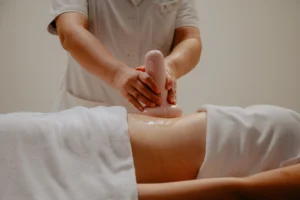
Ba Liao therapy targets eight sacral points on the lower back, stimulating pelvic circulation and regulating the autonomic nervous system that governs reproductive organs. This needleless option suits patients preferring treatment without needles. Treatment sessions involve gentle stimulation of these eight points, often combined with warmth therapy to enhance circulation.
Customised Traditional Chinese Medicine for Metabolic Balance
Customised Traditional Chinese Medicine address individual PCOS presentations. Formulas warming Kidney Yang include Cordyceps, Cinnamon, and Dried Ginger. Herbs moving Liver Qi include Bupleurum and Cyperi Rhizoma. Spleen-strengthening herbs like Atractylodes and Poria support digestion and reduce dampness accumulation.
Modern formulations arrive as convenient pills, powders, or syrups rather than requiring time-intensive boiling, making integration into busy Singapore lifestyles straightforward.
Acupuncture for Hormonal Regulation
Fertility acupuncture targets points known to influence hormonal signalling and reproductive function. Regular treatment (typically once weekly during preparation phases) helps stabilise cycle length, improve menstrual flow quality, and support ovulation restoration.
Womb Care Therapy and Moxibustion
Womb care therapy combines herbal paste application to the lower abdomen with gentle heat therapy, warming what TCM describes as a “cold uterus.” Moxibustion (burning of mugwort herb above specific points) provides deeper warming penetration. Many women find this deeply restorative, particularly during premenstrual phases when pelvic tension peaks.
Integrating TCM with Western Fertility Treatments
For women pursuing IVF or IUI alongside PCOS management, integrated TCM support optimises biological preparation and reduces cycle-related stress. The 90-day egg maturation window provides an ideal timeframe for TCM optimisation before stimulation begins.
Supporting IVF and IUI
TCM treatment during the three months preceding IVF improves ovarian blood flow, reduces systemic inflammation, and strengthens the uterine lining. During active stimulation, acupuncture continues to support comfortable side effect management and psychological resilience. Around embryo transfer, targeted acupuncture sessions immediately before and after transfer support implantation readiness.
For comprehensive guidance on IVF timeline integration, explore our dedicated IVF support guide.
Frequently Asked Questions
At what age does PCOS typically start?
Ovarian changes characteristic of PCOS often begin in late teens or early twenties, though symptoms may not become noticeable until mid-twenties or thirties. Some women receive diagnosis only when pursuing fertility treatment in their thirties or forties, despite the condition having existed for years. Earlier recognition allows for proactive metabolic management before fertility challenges emerge.
Can the condition resolve on its own?
PCOS persists as a lifelong condition; ovarian morphology doesn’t normalise without intervention. However, metabolic dysfunction underlying PCOS responds remarkably well to lifestyle optimisation, weight management, and targeted TCM treatment. Many women experience significant symptom improvement and even restore ovulation through dedicated multi-modal approaches.
Can women with this syndrome get pregnant?
Yes. Many women with PCOS conceive naturally once ovulation restores through metabolic optimisation, lifestyle changes, and/or TCM support. Others pursue assisted reproductive technologies with excellent outcomes. The key involves addressing insulin resistance and supporting ovulatory function through whatever modalities align with individual health goals and preferences.
Why Choose Wo.men Matters for TCM
At Wo.men Matters, we understand that PCOS affects not only reproductive function but overall metabolic health, emotional wellbeing, and quality of life. Our bilingual physicians, trained in both Traditional Chinese Medicine and biomedical sciences, provide nuanced, compassionate care addressing both ovarian and metabolic dimensions of your health.
Our TCM physicians assess your unique PCOS presentation, consider your lifestyle and preferences, and design personalised treatment combining acupuncture, customised traditional Chinese medicine, womb care therapy, and lifestyle counselling. We work safely alongside your fertility specialist or GP, ensuring coordinated care without contraindications.
Integrating TCM support into your care routine provides a grounded, holistic way to optimise PCOS management while aligning with your broader fertility and health goals. Bringing any recent test results or ultrasound reports allows our physicians to review these alongside your menstrual history, ensuring every aspect of your overall health picture is carefully evaluated.
Your path to balanced hormones and restored wellbeing begins with understanding your unique health pattern and receiving support tailored to your specific needs.